In short: behind the forehead there is an air-filled cavity, the frontal sinus, covered by a thin wall of bone. Shaving that wall barely changes the contour before it breaks through. That is why, in most of the foreheads we operate on, we remove it, reshape it and put it back further in. This is known as Type III forehead reconstruction or anterior wall setback.
What is behind your forehead
In almost every first FFS consultation we hear the same question: "Can't you just shave the forehead down?". It makes sense. If there is too much bone, you remove it. The problem is that, in most cases, there is not too much bone: there is too much projection.
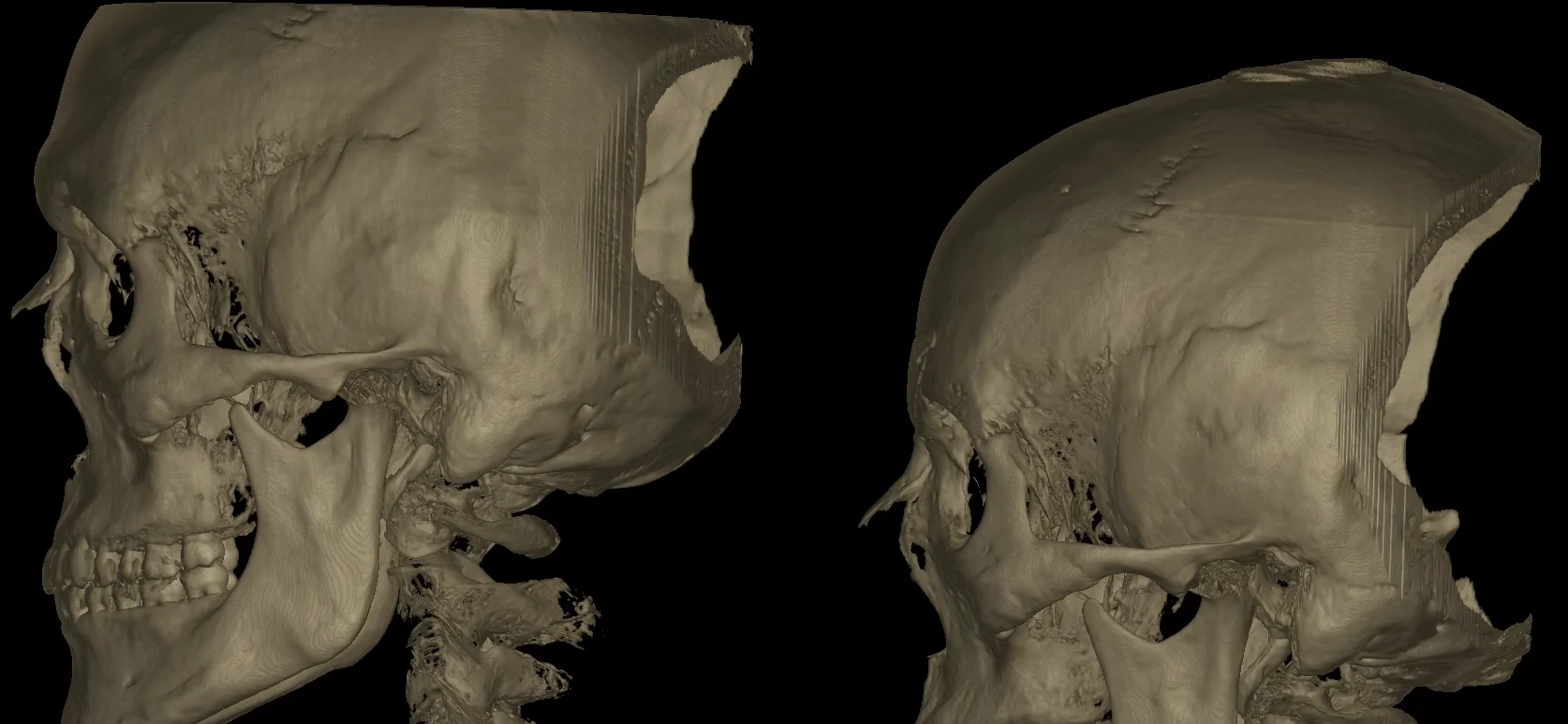
Just above the eyebrows there is a hollow space, the frontal sinus. The part you feel when you put your hand on your forehead is its front wall. In most of the cases we see, that wall is about 3 millimetres thick [1, 2]. That is all the margin there is to shave.
The eggshell: why shaving is not enough
An eggshell explains it well. It is curved, thin and hollow inside. If you try to sand it flat, you do not flatten it: you break through it first.
The forehead works the same way. It can be shaved a little, yes. But that little often makes no change that shows from the outside. And there is no point in opening that area to take back two millimetres that nobody will notice.
That is why we say that most forehead surgeries need a setback to be effective. It is not a technical preference: it is what the anatomy allows.
What we do instead: anterior wall setback
In the large majority of our cases, around 95% in our experience of more than 1,000 surgeries, we do not shave that wall. We remove it. The process has four steps:
- Remove the anterior wall with a precise, guided ultrasonic cut.
- Check the frontal sinus, which is now exposed: we confirm that the lining and the drainage duct are healthy.
- Reshape the wall outside the face, on both surfaces, and contour the rest of the fronto-naso-orbital complex to the planned shape.
- Reposition it deeper and with a new curve, fixed with titanium miniplates and microscrews.
Take the shell out, reshape it and put it back. Put that way it sounds bigger than shaving, and it is. But it is what makes a real change in contour possible when the anatomy leaves no more margin.
In the surgical literature, this technique is described as Type III in Ousterhout's classification [3], which groups foreheads by their anatomy and the correction they need. Like any surgery, it carries risks, which we review with you at the consultation and in the informed consent.
The surgical fees are the same for shaving and for setback. If only shaving is needed, the final price is slightly lower, because no fixation material is used. We explain this in why forehead surgery costs €8,500 at ARQÉA.
When shaving is enough
To be fair: not all foreheads are the same. Between 5% and 10% of people have a solid frontal sinus, with no air cavity, or a very small one [1]. In those cases, shaving is sometimes enough. The same applies when the projection is mild, although many of those foreheads do not need surgery at all. When shaving is enough, there is no reason to do more.
What we do not think is honest is promising a change that those three millimetres cannot deliver. That is why the first step is never choosing the technique. It is looking at the CT scan to see what is behind. In the forehead, what decides is not what you see on the outside but what lies inside.
The approach: where we go in
The setback can be done through any of the three usual approaches to the upper third, all running from ear to ear. What changes is where the scar sits and what else each approach allows.
- Hairline (pretrichial): the only one that brings the hairline forward and shortens the forehead. In exchange, the scar is more exposed.
- Coronal: the scar is hidden within the hair, and it makes a significant brow lift easier. It usually raises the hairline slightly.
- Posterior: the scar sits behind the crown, in the area with the lowest tension and the least affected by hair loss. It does not bring the hairline forward.
The scalp approaches also allow a simultaneous hair transplant. We choose the approach with you, according to your priorities: forehead length, hair density, brow position or how you feel about a visible scar. We explain it in detail in our post on forehead approaches.
There is no single feminine forehead
Setback is a tool, not a mould. There is no single feminine forehead shape: there are many, and all of them can be harmonious. That is why we never operate on two foreheads the same way.
Within the same procedure we work on each area separately, according to your anatomy and what you are looking for:
- Frontal bossing: the overall curve of the forehead, from top to bottom.
- Supraorbital rim: the ridge just above the eyebrows, which is what most "hardens" the eyes.
- Nasal root: the transition between forehead and nose, which defines the profile.
- Lateral orbital rim: the outer corner of the eye socket, which affects how the eyes are perceived.
- Brow position: their height and shape, which we can adjust in the same surgery.
Some patients want a very soft, rounded forehead. Others prefer to keep some character. Both are valid. We review it together on your CT scan with prior virtual planning, before deciding anything.
Before you decide
If you are considering forehead surgery, the first question is not "shave or set back?". It is "what is behind my forehead, and what do I want to achieve?". Answering it takes a CT scan and an honest conversation.
If you would like us to assess your case, the first video consultation is free.
References
1. Sahlstrand-Johnson P, Jannert M, Strömbeck A, Abul-Kasim K. Computed tomography measurements of different dimensions of maxillary and frontal sinuses. BMC Med Imaging. 2011;11:8. https://doi.org/10.1186/1471-2342-11-8
2. Lee MK, Sakai O, Spiegel JH. CT measurement of the frontal sinus: gender differences and implications for frontal cranioplasty. J Craniomaxillofac Surg. 2010;38(7):494-500. https://doi.org/10.1016/j.jcms.2010.02.001
3. Ousterhout DK. Feminization of the forehead: contour changing to improve female aesthetics. Plast Reconstr Surg. 1987;79:701-713.
As we always say, this article is for general information and doesn't replace an individual medical assessment. If you want to know what your forehead needs, book a consultation with our team.
→ Book your free consultation now