First of all, a clarification we usually give at the consultation: facial implants are a purely aesthetic resource. That doesn't make them frivolous. Correcting a projection or symmetry defect that bothers you is as legitimate a reason as any, but it does draw a clear line: a well-conceived implant should neither improve nor worsen any function. If it touches bone, nerve or any functional structure, something was planned badly.
With that said, let's get to the point.
Why PEEK
We work with PEEK (polyetheretherketone) for custom implants. It's a material with a long track record in craniomaxillofacial surgery, with concrete advantages: high mechanical strength, excellent biocompatibility and, something rarely valued outside the theatre, it's radiolucent (it doesn't interfere with later imaging). It's milled to measure from each patient's surgical plan, so the result doesn't depend on a prefabricated piece that "approximates" what you need.
Personalisation is the easy part to say and the hard part to do
Everyone talks about "custom implants" as if the design solved itself just by working with a mouldable material. It doesn't. Personalising well requires clinical judgement and translating what the patient wants into a design that works with their real anatomy, not with a template.
Why implants have a bad reputation (and why it isn't fair)
Almost all the failures behind that reputation of "implants that cause trouble" come from one of these three faults, not from the implant itself:
- The wrong material. Silicones that don't adapt to the bone contour or that shift over time.
- A badly judged design. Too large, and the result looks artificial. Too small, and it doesn't achieve what the patient wanted. Two different forms of the same error: failing to translate the goal into real volume.
- Poorly executed placement. A well-designed implant, badly positioned, causes problems in the short or medium term that sometimes end in removal.
None of the three is a material problem. It's a process problem.
The most predictable areas
Not every area of the face behaves the same with an implant. There are three where the result is most predictable: chin, jaw angles and cheekbones. These are areas with consistent bone support and a relatively uniform soft-tissue envelope across patients, which makes it easier to anticipate how the implant will integrate.
That said, practically any facial area can receive a custom implant if the case justifies it, but outside those three zones the planning demands a more individualised analysis, because the anatomical variability is greater and the margin of predictability smaller.
What an implant must deliver, no exceptions
Wherever it's placed, three conditions are non-negotiable:
- The muscle must not "catch" on it. A badly designed edge means the muscles in the area collide with the implant on every movement, causing discomfort, an irregular contour with expression and sometimes displacement over time. It's avoided with a correct transition design and, above all, precise placement: the margin for error here is minimal.
- The size must not interfere with function. A well-conceived implant shouldn't be noticeable when speaking, chewing or making expressions. If it causes any functional limitation, it's the wrong size.
- It must respect the areas of high sensitivity. Some regions carry nerve pathways that have to be identified and respected in the design. If the implant invades that space, the result is irritation, discomfort or altered sensation that has no reason to be part of the recovery.
Why patients ask
The most common reasons patients ask us about custom implants:
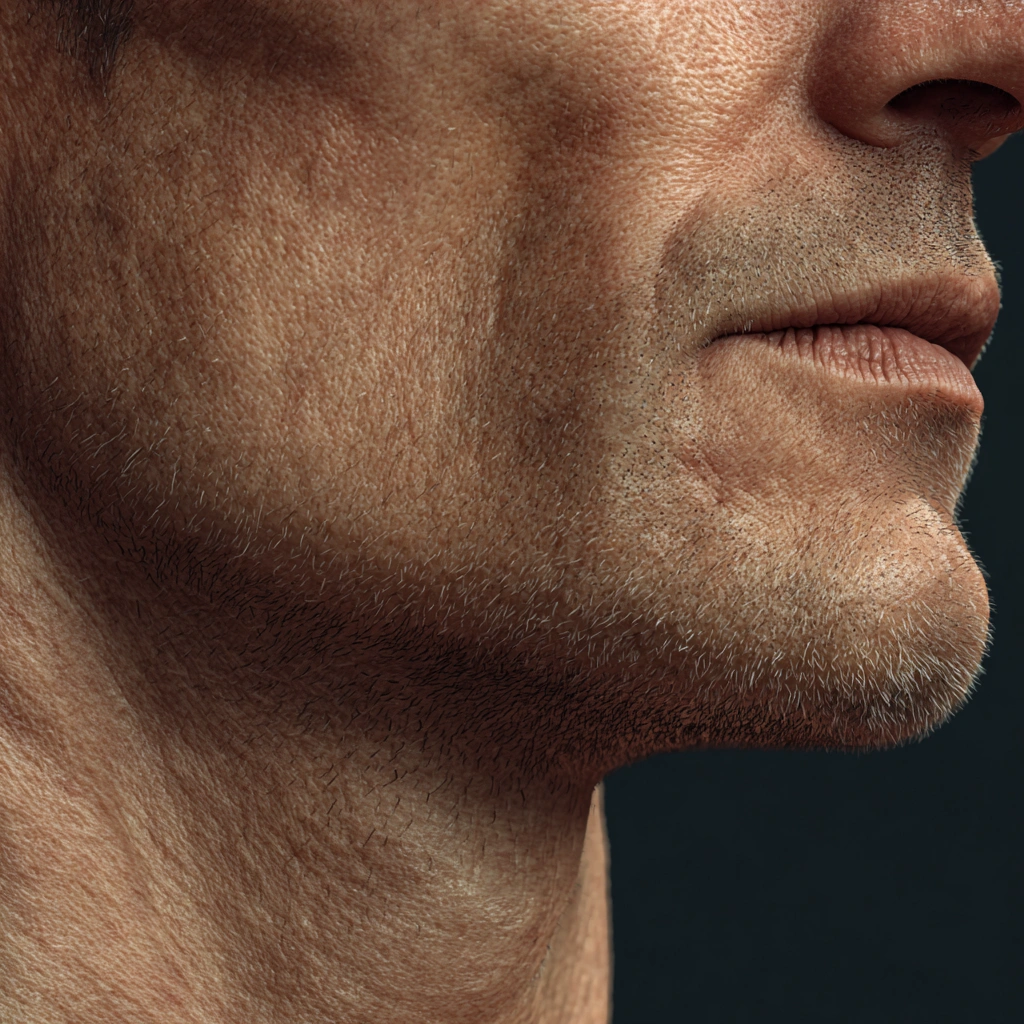
- Achieving a more masculine look in the lower third.
- Gaining squareness in the jaw.
- A more defined or angular jawline.
- A more projected chin.
- Correcting a flattened midface, adding volume or width in the cheekbone area.
Different goals, but all sharing the same foundation: it isn't a new face, it's correcting a specific feature the patient identifies as the one breaking the balance of the whole.
What a well-made implant really is
When the material is right, the design answers the patient's real goal and the placement is precise, we're talking about surgery of short duration, done as a day case, with a recovery that, in our experience, is noticeably quicker than that of other operations pursuing the same aesthetic goal through more invasive routes. It's also a cost-competitive option compared with larger surgical alternatives for correcting the same kind of defect.
In summary
A custom implant isn't a shortcut or a patch. It's a precision tool that, well chosen, well designed and well placed, resolves specific defects without the need for major surgery. The bad reputation it drags along comes from the cases where one of those three steps failed, not from the concept itself.
As we always say, this article is for general information and doesn't replace an individual medical assessment. If you want to know whether your case fits this profile, book a consultation with our team.
→ Book your free consultation now