In short: whenever possible, we operate on the chin using your own bone. We move and sculpt the chin you already have, with as little fixation as possible. We choose an implant when the goal is to add volume while changing the shape, for example to go from a rounded or pointed chin to a squarer one.
Why we prefer your own bone
It is the recurring question in consultation. Our answer is clear: if your bone can give you the result you are looking for, we use it. There are three reasons.
- It is your own tissue. No foreign body is left taking up volume under the skin. The bone we move heals and integrates.
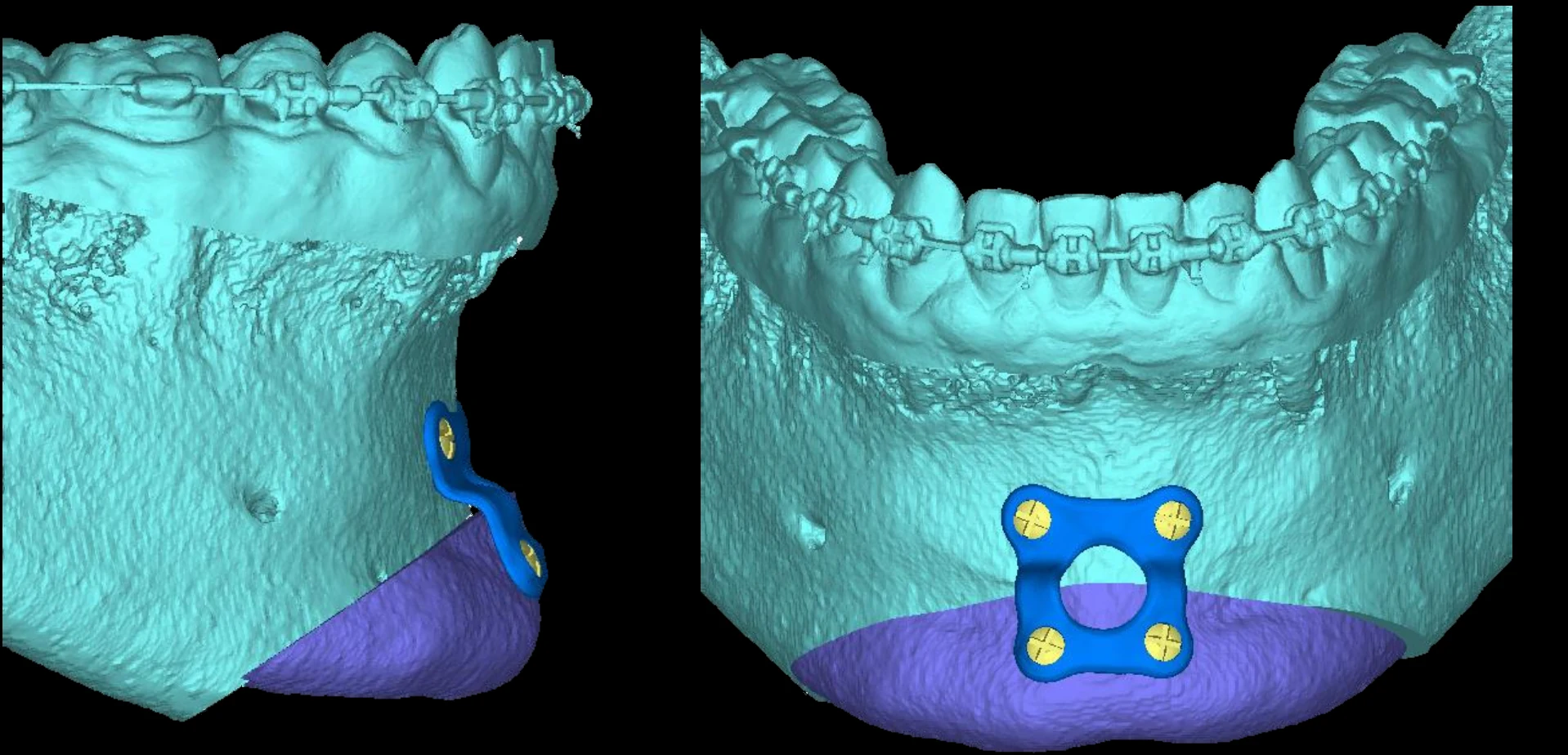
- Minimal fixation. We fix it with two bicortical screws or a single titanium miniplate. It is not "no material", but it is the smallest amount possible.
- Planned, guided and custom-made. We design the movement on your CT scan with prior virtual planning and transfer it to theatre with cutting guides. What is decided in the plan is what is carried out.

What your own bone can achieve
With a chin osteotomy (genioplasty), we separate the lower segment of the bone and reposition it where it is needed. This allows us to:
- Advance a retruded chin.
- Lower a short chin to lengthen the lower third.
- Shorten a chin that is too long.
- Correct asymmetries, shifting or rotating it towards the midline.
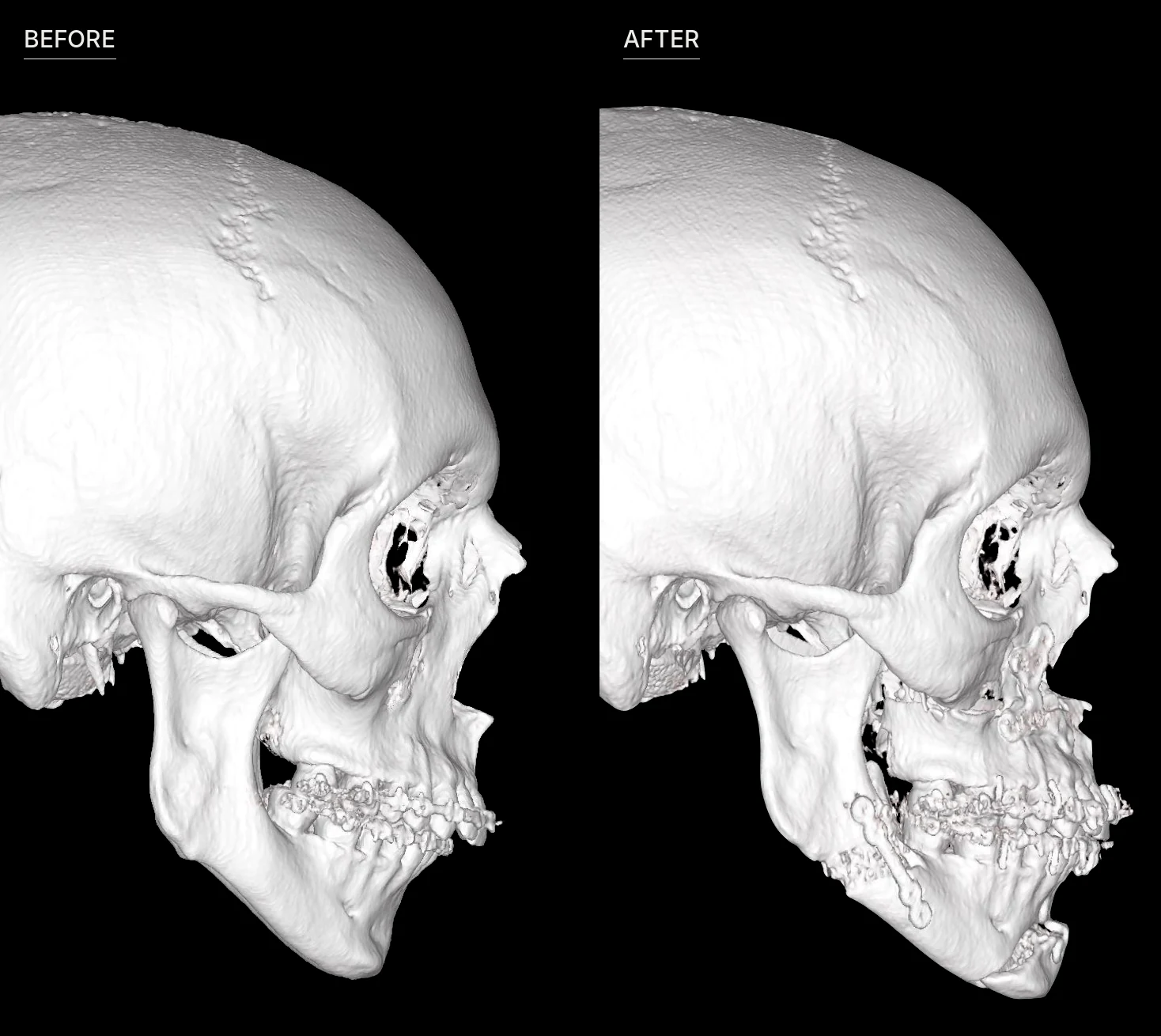
And it is not only moved: it is also sculpted. With burring and recontouring techniques we can reduce its size, projection or width, and change its shape. It is sculpting work on your own bone.
When we do not use your own bone
Bone can be moved, shortened and sculpted. What it cannot do is create new volume with a different shape from the one it has. If your chin is rounded or pointed and you want a squarer, wider one, moving it is not enough: something has to be added.
This is the most common situation for people looking for a squarer lower third, including many facial masculinisation patients. In those cases, our preferred material is PEEK: an implant designed to measure on your CT scan, with the exact shape we plan. We explain why in our post on custom PEEK implants.
Bone or implant at a glance
| Your own bone (osteotomy + recontouring) | Custom implant (PEEK) | |
|---|---|---|
| What it does | Moves, shortens and sculpts the chin you already have | Adds volume with a new shape |
| Typical indication | Advance, lower, shorten, correct asymmetries, reduce | Go from a rounded or pointed chin to a square one |
| Material left in place | 2 bicortical screws or 1 titanium miniplate | The implant and its fixation screws |
| Can it reduce size? | Yes | No |
| Planning | Virtual, on CT, with cutting guides | Virtual, on CT, custom design |
Neither option is risk-free
Preferring bone does not mean it has no risks, although they are not the ones many patients imagine.
Our approach is minimally invasive: a 1 to 1.5 cm incision inside the mouth, on the inner side of the lower lip, placed higher than the conventional one. Through it we section only a small part of the chin muscle to reach the bone, and we open just a tunnel where the cut, the cutting guide and the plate go. The guide is designed for this approach, to expose as little bone as possible. We make the cut with ultrasound, fix the bone with custom fixation material made from the plan, and close in two layers with dissolvable sutures, carefully repositioning the muscle.
With this approach we do not expose or dissect the mental nerve, which gives sensation to the lower lip and chin. Even so, as with any chin surgery, a temporary change in sensation can occur, although it is uncommon with this approach.

In a genioplasty, the soft tissues do not sag: when we advance or lower the chin, we give them more structure to rest on, and they usually improve. That risk does exist when the procedure is a recontouring to reduce the chin. Because we work through the chin muscle, a change in how it moves can occur, which is why we reposition it carefully when we close.
The other risks we take into account are damaging a tooth when placing the fixation, or necrosis of the mobilised bone segment if too much of its periosteum is stripped.
An implant avoids cutting the bone, but it introduces a foreign material, with its own risks: infection, displacement or exposure. We review all of this with you at the consultation and in the informed consent.
The choice does not depend on which technique is "better" in general, but on what your chin needs and what you are looking for. If you would like us to assess your case, the first video consultation is free.
As we always say, this article is for general information and doesn't replace an individual medical assessment. If you want to know which option suits your chin, book a consultation with our team.
→ Book your free consultation now