In short: an AI app can feminize a photo without touching any of the features treated in facial feminization surgery: what it usually changes is the skin, the make-up, the hair and the lighting. That image shows a wish, not a surgical plan. Bring it to your consultation: together we go through which changes are surgical, which are not, and what your anatomy allows.
A few weeks ago we received an enquiry with an image attached. The patient had run a photo of herself through an artificial intelligence app to "see herself feminized" and wrote to us: "I want this".
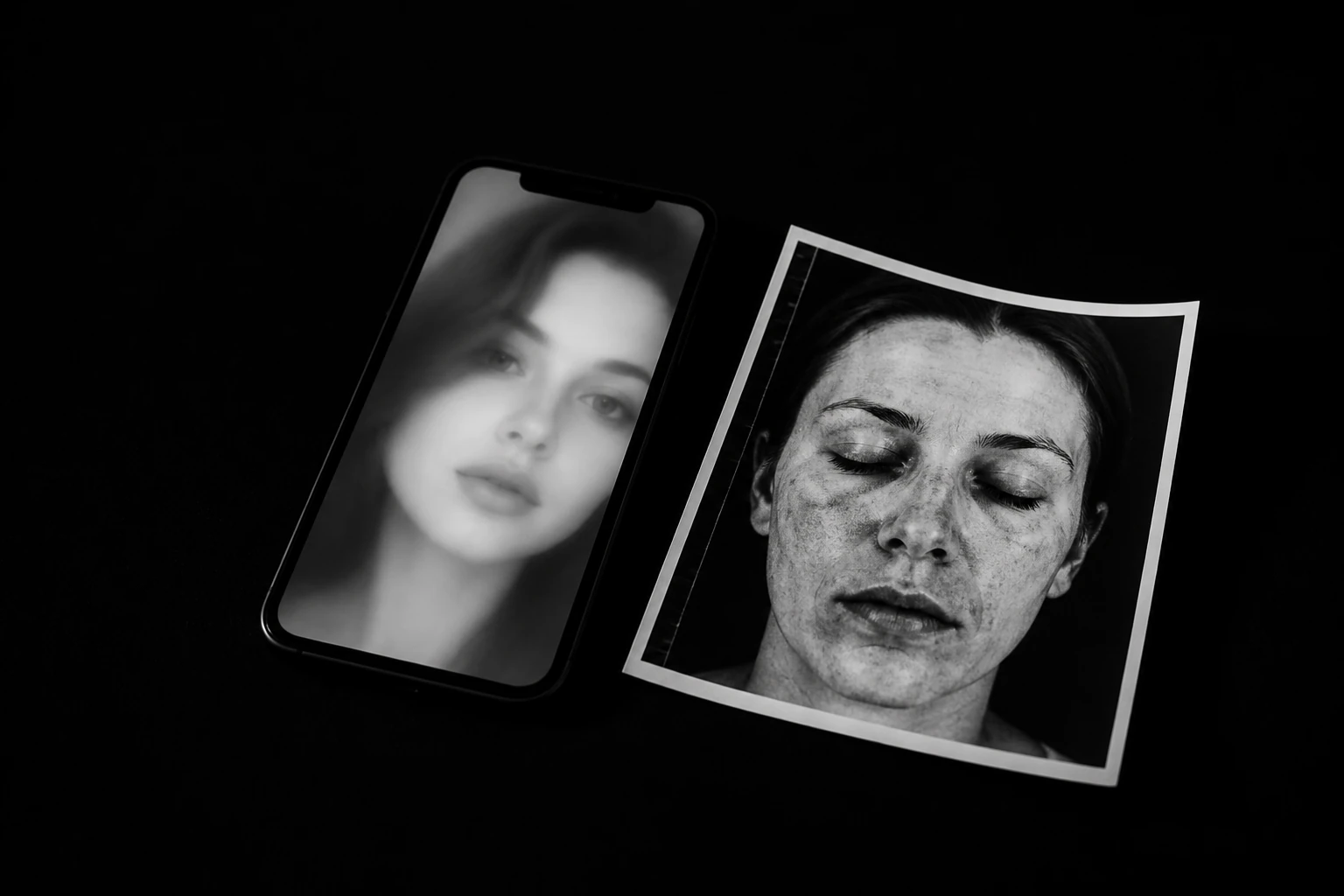
We looked at the image calmly, side by side with the original photo. The forehead was the same. The nose, practically identical. The jaw angle and the chin, untouched. What had changed was something else: the skin (no pores, no texture, not a single blemish), the make-up, the hair and the lighting.
In other words, the AI had feminized the face without touching any of the features treated in facial feminization surgery. And it is not an isolated case. We receive more and more images like this.
What these apps actually do
A generative app knows nothing about your anatomy. It does not know the thickness of your frontal bone, where your frontal sinus is, the path of your nerves, how much soft tissue you have over your chin or how your skin heals. What it does is generate an attractive image, based on millions of faces it has seen before.
To get there, it usually relies on the same tricks:
- It smooths the skin and removes texture, wrinkles and blemishes.
- It blurs the contours, so that a strong jaw or a prominent forehead "softens" without anyone moving a millimetre of bone.
- It improves the angle and the lighting, which completely change how a face is perceived.
- It retouches proportions: slightly bigger eyes, a slightly thinner nose, slightly fuller lips.
The result is an image that shows you what you would like to see. The problem is that it has no obligation to show you how to get there, or even whether it is possible to get there.
Surgery has limits (and that is a good thing)
This is what a generated image will not tell you:
- Bone moves within what your anatomy allows. We can reduce a forehead, change a chin or reshape a jaw angle, but always within margins that depend on your structure, not on what an algorithm asks for.
- Soft tissue does not copy the bone one hundred per cent. When we move bone, the skin and fat covering it follow, but not exactly, and not in the same way in every person.
- No bone surgery changes the quality of your skin. If what you like most about the simulation is porcelain skin, that is not achieved in a facial surgery theatre.
- Healing is yours. Swelling, small asymmetries, recovery times: these are real variables that a perfect image erases.
When expectations are built on an image that ignores all of this, the risk is not only that the result disappoints. It is that a good surgical result is experienced as a failure, because it is compared with something that was never achievable.
This is not new, but now it moves faster
In 2018, an opinion piece published in JAMA Facial Plastic Surgery already described how social media filters were bringing patients to consultations with retouched selfies, asking to look like their filtered version (Rajanala et al., 2018). The authors warned that these images blur the line between reality and fantasy.
The difference today is that we are no longer talking about a filter that smooths the skin, but about tools that can generate a new face in seconds, with an apparent realism that makes it very hard to tell which part is yours and which part is invented.
In facial feminization, the problem is twofold
In feminization there is a nuance we think matters.
Many people use these apps to imagine themselves, and that has enormous emotional value that we do not want to play down. Seeing yourself, even on a screen, can be an important first step.
But what makes a face "read" as feminine in these images is usually a mix of things: some are bone features that surgery does work on (forehead, orbital rim, nose, jaw, chin), and some are hair, skin, make-up and expression, which do not depend on the operating theatre.
Separating one from the other is exactly what AI does not do. And sometimes, when we do it at the consultation, we discover something surprising: that part of what the patient is looking for is not surgical, or that she needs less surgery than she thought. That is valuable information too.
We are not against technology
Let us be clear: we are not against using simulations. In fact, for certain procedures they can be a very useful tool for adjusting expectations and helping patient and surgeon speak the same language.
The difference lies in which tool, and in whose hands:
- A useful simulation starts from your real records: standardized medical photographs, a facial surface scan and, when needed, a CT scan.
- It is built with prior virtual planning, respecting what your anatomy allows.
- It is made or supervised by the person who will operate on you, who knows which changes are achievable and which are not.
Even so, it has to be said: even the best simulation is an approximation, not a promise. It helps guide the conversation, not guarantee a result. Be wary of any image, wherever it comes from, that is presented to you as "this is how you will look".
So, should I bring my AI image to the consultation?
Yes, bring it. It helps us understand what you like, what bothers you about your face and where you would like to go. It is as valid a starting point as any other.
What we will do with it is translate it. Together we will go through which changes in that image are surgical, which are skin, hair or make-up, and which are not achievable with your anatomy. From there, we build a real plan, which is the only thing we can truly offer you.
In summary
An AI-generated image shows you a wish. A surgical plan shows you a path. The two can coexist, as long as we do not confuse one with the other.
Surgery has limits, and knowing them before you have surgery is not bad news: it is the best way for the result to look like what you expected.
Frequently asked questions
Can I bring an AI-feminized photo of myself to the consultation?
Yes. It helps us understand what you like, what bothers you about your face and where you would like to go. At the consultation we go through together which changes in that image are surgical, which are skin, hair or make-up, and which are not achievable with your anatomy.
Why doesn't AI show the real result of facial feminization surgery?
Because it does not know your anatomy: not the thickness of your frontal bone, your frontal sinus, your nerves, your soft tissue or how your skin heals. It generates an attractive image by smoothing the skin, blurring contours, improving the lighting and retouching proportions.
Does facial feminization surgery change your skin?
No. No bone surgery changes the quality of your skin. If what you like most about a simulation is skin with no pores or blemishes, that is not achieved in a facial surgery theatre.
Can a simulation show me how I will look?
A useful simulation starts from your real records (medical photographs, a facial scan and, when needed, a CT scan), is built with virtual planning and is made or supervised by the person who will operate on you. Even so, it is an approximation, not a promise: it guides the conversation, it does not guarantee a result.
References
- Rajanala S, Maymone MBC, Vashi NA. Selfies-Living in the Era of Filtered Photographs. JAMA Facial Plast Surg. 2018;20(6):443-444. doi:10.1001/jamafacial.2018.0486
As we always say, this article is for general information and doesn't replace an individual medical assessment. If you would like to review your expectations with our team, with or without an AI image, book a consultation.
→ Book your free consultation now