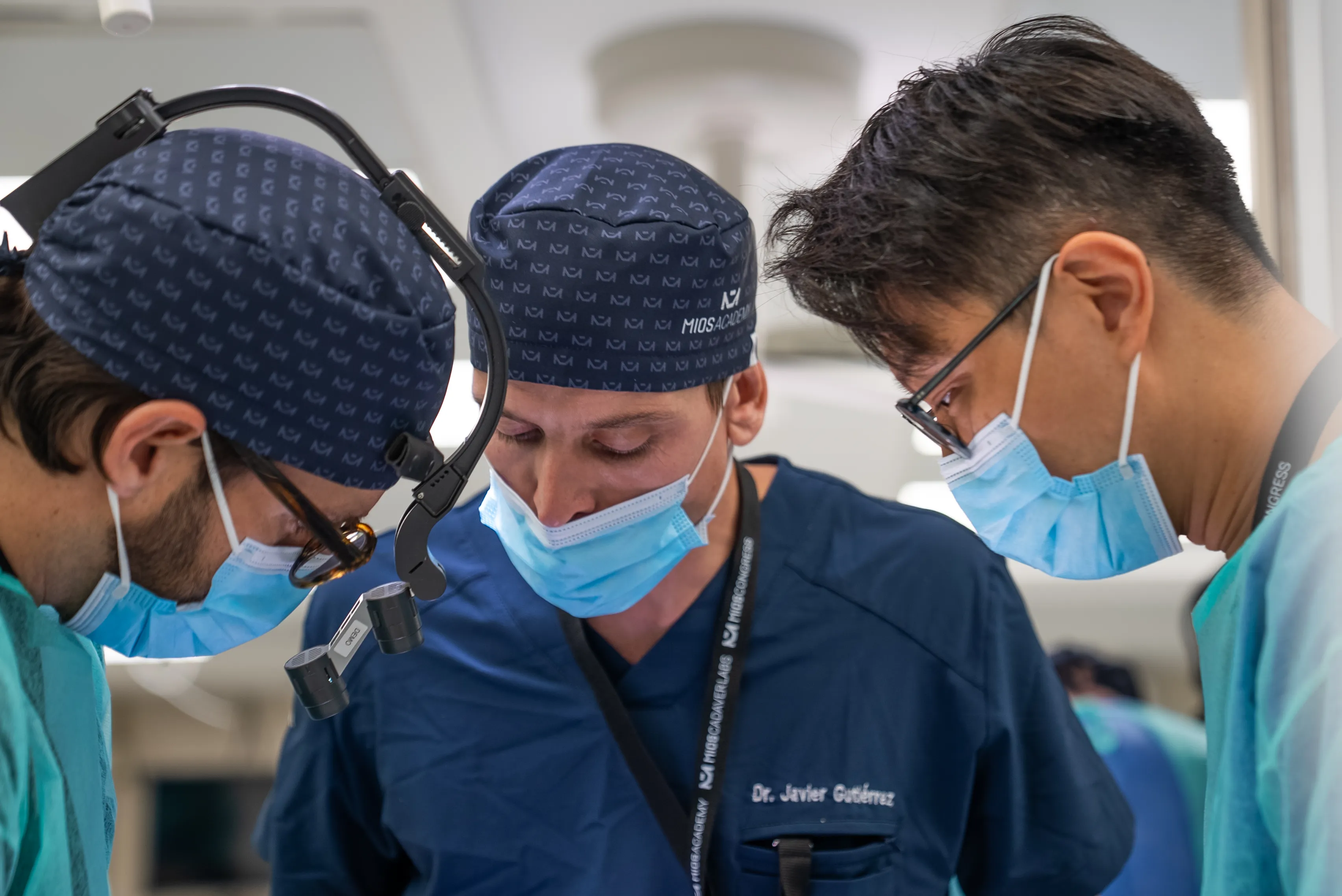

A question we're often asked is whether it's possible to combine your facial surgery with other procedures, body or genital, in the same operation or on the same trip. The short answer is: yes, in many cases it's possible, and we work in close coordination with IM Clinic/Gender to do it safely. The long answer is more interesting, and it's the one I'll give you here.
Two lines of combination
- Body surgery. Through IM Clinic/Gender you can combine your facial procedure with breast augmentation or reduction, with rib remodelling using the technique developed by Dr Mañero, or with 3D liposculpture, an area where the IM Clinic team are leaders.
- Genital surgery. Combining with vaginoplasty is also possible. Dr Mañero has dedicated more than 20 years to genital surgery and has treated over 3,000 patients, with a specialised team devoted to this type of operation. It's a very common combination, since it involves anatomically distant regions, allowing the surgeries to run simultaneously and shorten the overall timeline.
What is not the limiting factor
It's worth being clear here, because there's an idea in circulation that isn't quite accurate: the surgery itself (whether facial, body or genital) is not, by its nature or its severity, what determines whether it can be combined. Each of these surgeries, on its own, is perfectly manageable in terms of recovery.
What really decides whether a combination is safe and advisable are other factors, more technical and more personal.
What does determine whether we can combine
- Total surgical time. Each procedure adds minutes of anaesthesia and surgery. Combining is safe as long as the total time stays within margins that don't increase the anaesthetic or surgical risk. This is the first limit we assess, always on medical grounds and never to squeeze more into a single trip.
- The number of procedures combined. Combining two operations isn't the same as combining four or five. The more procedures accumulate, the more complex recovery becomes: more areas of the body to care for at once, more simultaneous mobility restrictions, more load on the body as a whole. Less, combined with good judgement, usually beats more.
- The surgical position. Some surgeries are performed lying face up and others face down. When two procedures require incompatible positions, or position changes that needlessly lengthen theatre time, that conditions what can be combined in the same session and what's better planned for separate stages.
- Your recovery expectations. This matters as much as the above, and it depends on you. If you need to get back to your life (work, family, routine) within a short timeframe, combining several procedures may not be the right choice, however technically possible it is. Recovering from a combination is, logically, longer and more demanding than recovering from a single procedure. Being realistic about your available time is part of making a good decision.
How we decide together
When we assess a possible combination, we do it jointly between our team and the IM Clinic/Gender team, looking at these four factors case by case, never generically. There's no single rule that works for every patient, because each combination depends on your anatomy, your health and your personal situation.
If you're interested in exploring combined surgery, tell us at your consultation. We'll assess with you what makes sense to combine, what's better spaced out over time, and above all, what's safest for you.
→ Book your free consultation now